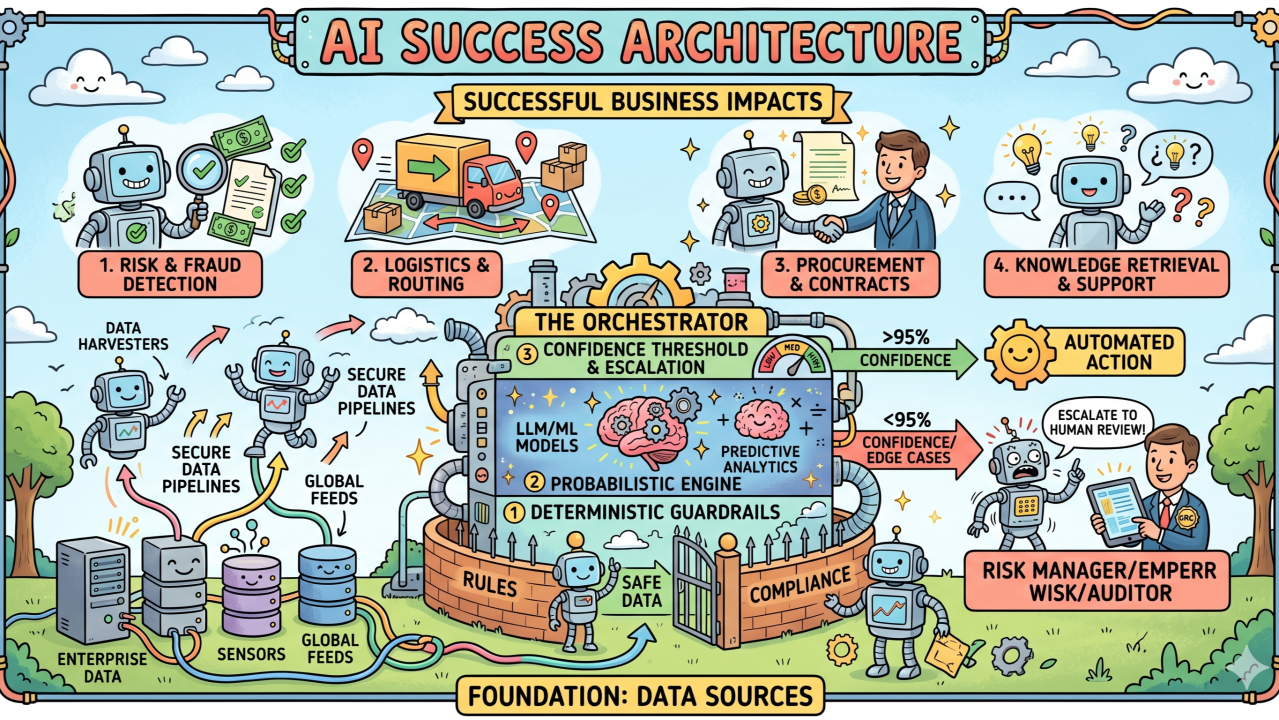
From Proof of Concept to Proof of Control: The New Architecture of Enterprise AI Success
As AI adoption matures, organizations are shifting focus from mere capability to reliable, transparent, and governed execution. This article highlights the critical need for robust control frameworks in enterprise AI deployments, moving beyond initial proofs of concept to ensure 'proof of control.' It emphasizes that successful AI integration hinges on strong governance, risk, and compliance (GRC) strategies, rather than just technological prowess.
The Evolution of Enterprise AI: From Sandbox to Scaled Operations
The landscape of Artificial Intelligence in enterprises has significantly evolved. Initial excitement around AI's potential, often demonstrated through isolated proofs of concept, has given way to a demand for reliable, transparent, and scalable AI applications. Boards and executive teams are no longer content with what an AI model *can* do; they are scrutinizing how safely, predictably, and transparently it performs at scale. This shift underscores a critical realization: the true differentiator for high-ROI AI deployments is not engineering brilliance alone, but robust governance.
Case Studies: Highlighting Governance Imperatives in AI Implementation
The article analyzes several prominent corporate AI implementations, revealing common governance challenges and solutions. These case studies illustrate how successful AI systems, while delivering significant yields, also expose distinct risk vectors that necessitate active internal oversight:
- Walmart's Autonomous Procurement: While achieving substantial cost savings, the AI's algorithmic value matrices require continuous internal audit to ensure parameter integrity, adapting to macroeconomic shifts to prevent systematically disadvantageous contracts.
- Morgan Stanley's AI Assistant: This tool significantly reduces research cycles, but its legal compliance depends on rigorous data hygiene and semantic versioning to prevent the synthesis of conflicting or non-compliant advice from outdated information.
- JPMorgan Chase's COiN Platform: By automating legal clause extraction, the platform saves immense manual review hours. However, its neural network's lack of innate transparency demands a separate, independent logging architecture for explainability (XAI) to trace data lineage for regulatory compliance.
- Klarna's AI-Driven Customer Operations: Handling a large volume of customer service, this AI matches human satisfaction scores and drives profit. Yet, in regulated sectors, risk teams must implement 'Friction-Point Protocols' with 'Hard-Stop' thresholds to ensure human intervention in sensitive compliance categories like financial hardship or fraud.
The Three-Tier Control Pattern and the Mandate for Continuous Governance
Organizations achieving sustained ROI from AI implement a 'Three-Tier Control Pattern' to decouple risk from technology. This involves:
- The Deterministic Filter: Establishing rigid rules and guardrails before the AI model runs, such as hardcoded financial floors or granular access controls.
- The Probabilistic Engine: Utilizing the AI model strictly within these predefined boundaries for tasks like interpreting unstructured data or summarizing text.
- The Escalation / Audit Layer: Programming the system to trigger human hand-offs when confidence scores fall below a threshold or high-risk compliance categories are touched.
For Internal Audit and Compliance, this necessitates a pivot towards 'Continuous Governance.' This means moving from traditional sampling to 100% population testing of AI outputs, enforcing rigorous data governance with automated deprecation and metadata tagging, and managing third-party dependency risk by building 'Model-Agnostic' resilience. Ultimately, successful AI deployment is framed as an accounting and control challenge, where robust guardrails ensure that innovation and speed do not compromise corporate integrity.
Read more
