Ex-Auditors: The Unexpected AI Power Users in Finance
This article argues that former auditors are uniquely positioned to leverage AI in finance due to their expertise in process walkthroughs. Their ability to meticulously document and understand financial processes provides the essential input AI needs to deliver meaningful automation and insights. The author outlines a practical four-step method for finance professionals to apply this audit-honed skill to their own workflows, using AI to identify and implement automation opportunities.
The Undervalued Skill of Process Walkthroughs
The author, Jacob Krogue, CPA, posits that the most undervalued skill for effective AI utilization in finance is the process walkthrough, a core competency of auditors. Many finance professionals, including CFOs who often have an audit background, possess this skill but fail to apply it to their internal workflows. The common pitfall with AI in finance is attempting to use it without a deep understanding of the underlying processes, leading to mediocre results. AI, much like a new hire, cannot optimize what it cannot fully comprehend, highlighting a critical documentation gap that auditors are inherently equipped to fill.
Auditors' Unique Advantage in AI Implementation
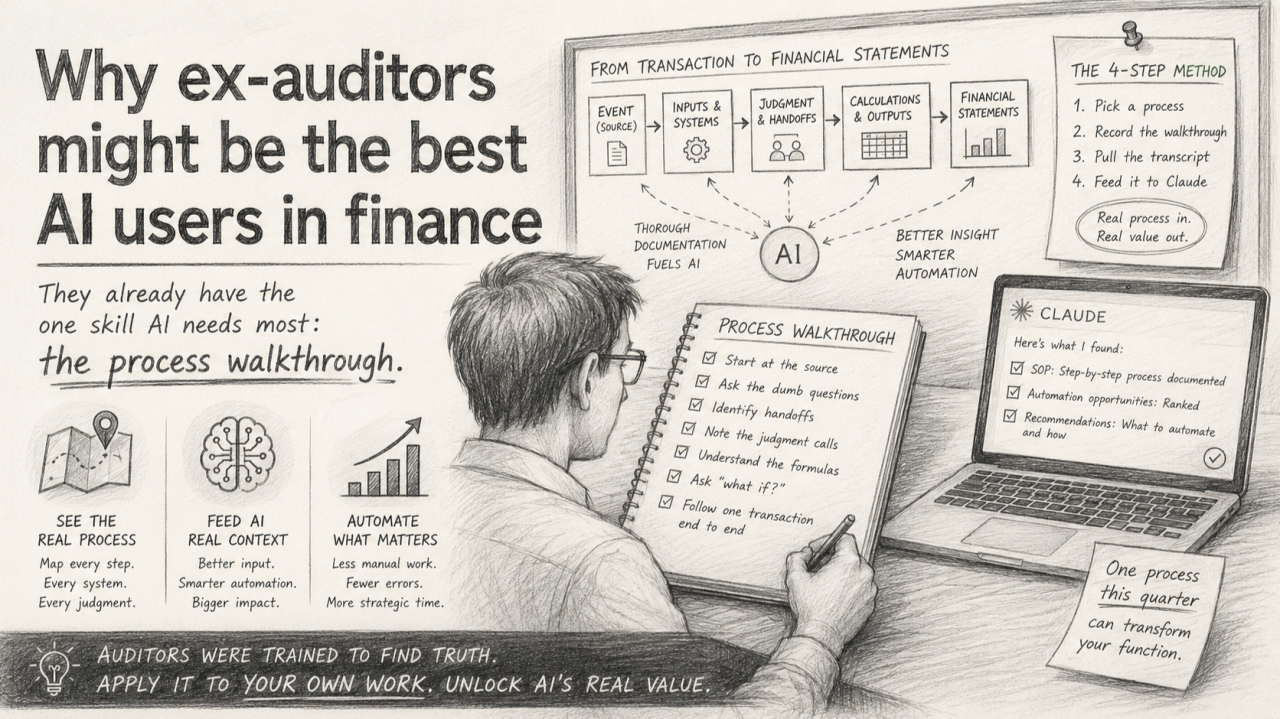
Auditors are trained to conduct thorough process walkthroughs, meticulously tracing a single transaction from its inception to its final impact on financial statements. This involves documenting every step, system, judgment call, and handoff. This detailed approach, which identifies potential error points and critical decision-making junctures, generates the precise, granular input that AI models require to be truly effective. Key elements of an effective walkthrough include:
- Starting at the source of an event, not just where data lands.
- Asking fundamental "dumb questions" to uncover hidden assumptions.
- Identifying handoffs, where errors frequently occur.
- Documenting judgment calls and the rationale behind them.
- Understanding formula mechanics and potential breaking points.
- Exploring "what if" scenarios to test process resilience.
- Following one real transaction end-to-end, rather than abstract processes.
A Practical Framework for AI-Driven Automation
Krogue provides a four-step method for finance teams to harness this audit skill for AI-driven automation:
- Pick a Process: Select a repetitive, rules-based, and often painful process (e.g., month-end close subroutines, commissions, lease accounting).
- Record the Process: Document the process owner performing the task, narrating every click, formula, and judgment call as if training a new hire.
- Transcribe the Recording: Utilize transcription tools to convert the narration into text.
- Prompt AI: Feed the transcript to an AI (like Claude) with a specific prompt to: (a) document the process in an SOP format, (b) identify automation candidates, and (c) recommend the best automation approach (traditional, AI in Excel, or AI agent) with reasoning.
This approach yields tangible benefits for CFOs, including a clear roadmap for automation, specific starting points for investment, and a practical method to evaluate AI solutions against actual business processes, offering a more effective outcome than many traditional consulting engagements.
Read more
