12 Modern Internal Audit Capabilities: Beyond Software, Towards Execution
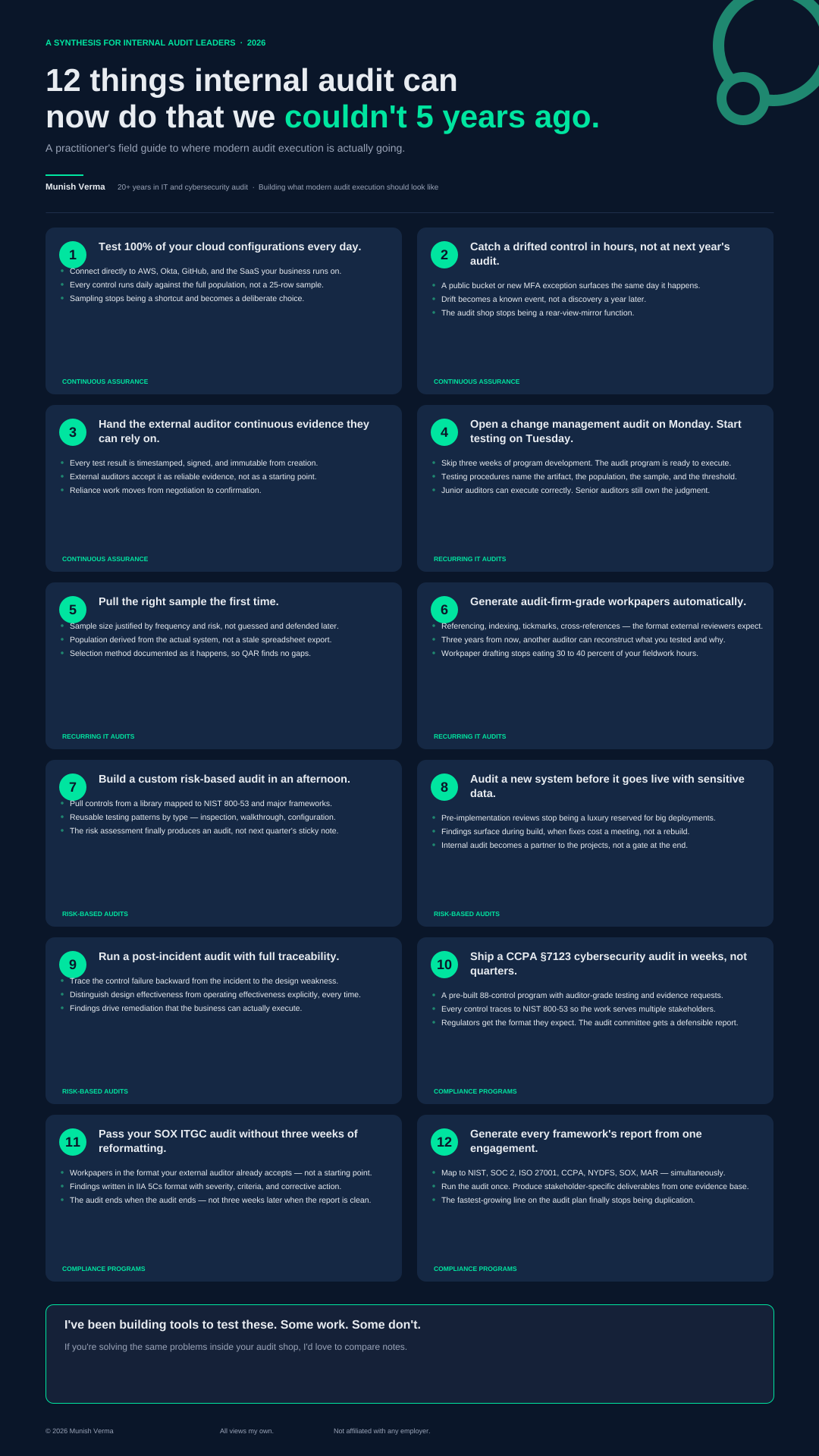
Munish Verma highlights 12 modern capabilities internal audit can leverage today, focusing on transforming audit execution rather than just the management software. These advancements, categorized across continuous assurance, recurring IT audits, risk-based audits, and compliance programs, aim to reduce manual effort and enhance the auditor's strategic role. The article encourages audit leaders to consider which of these capabilities their teams are already utilizing and which they aspire to implement.
Modernizing Internal Audit Execution
Munish Verma's post emphasizes a critical shift in internal audit: moving beyond mere software upgrades to fundamentally modernize the execution of audit work itself. This perspective suggests that while audit management software is important, the true potential for transformation lies in how auditors perform their tasks. By focusing on the 'work itself,' internal audit can unlock efficiencies and elevate its strategic value within organizations.
Key Areas of Transformation
The article identifies 12 actionable capabilities, grouped into four key areas, that internal audit can now implement. These include:
- Continuous Assurance: Leveraging technology for ongoing monitoring and real-time insights, moving away from periodic, point-in-time audits.
- Recurring IT Audits: Automating and streamlining repetitive IT audit tasks, freeing up auditors for more complex analysis.
- Risk-Based Audits: Enhancing the precision and effectiveness of risk identification and assessment through advanced techniques.
- Compliance Programs: Improving the efficiency and coverage of compliance checks and reporting.
These advancements are designed to take the 'heavy lifting' off auditors, allowing them to focus on critical thinking, risk interpretation, and providing strategic oversight.
Impact on Audit Professionals
For audit and assurance professionals, Verma's insights underscore the evolving landscape of the profession. The integration of these modern capabilities means a greater reliance on technology to automate routine tasks, thereby increasing the demand for auditors with strong analytical skills, a deep understanding of risk, and the ability to interpret complex data. The goal is not to replace the auditor but to augment their capabilities, enabling them to deliver higher-value assurance and advisory services to their organizations.
Read more
